One knowledge map. Many shop-floor problems.

Start with the product you need, then extend the accumulated knowledge to other areas.

From wearable-camera footage and existing records,
we build your knowledge map.

Minimal extra data entry — we build on the records you already have. From footage of everyday work and your existing records, AI organizes the know-how.

  1. 01

    Record

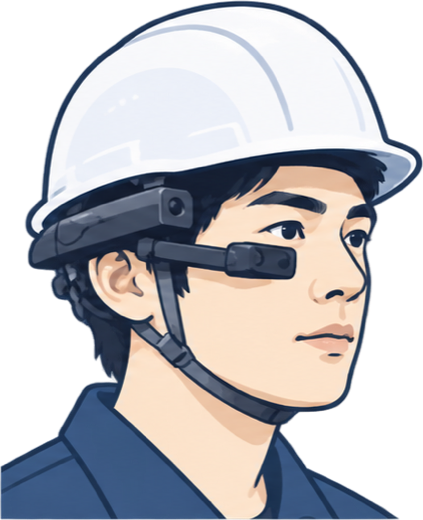
    A helmet-mounted camera captures the work on video, with the operator explaining out loud.

  2. 02

    Collect

    Bring in existing failure and inspection logs, manuals, drawings and equipment alarms.

  3. 03

    AI connects

    AI reads equipment, parts, processes, tasks, anomalies and records, and maps how they relate.

What the knowledge map looks like

Equipment, processes, tasks and anomalies — connected as a knowledge graph.
When something goes wrong, follow the relationships to likely causes and fixes.

Knowledge mapDoor-mirror assembly line(Part supply〜Function test)

Part supply Robot assembly Fastening Function test feeds records next next shows fastens uses steps detects cause occurs at fix Part lot Receiving log Robot assembly Work video Fastening Fixing screw Nutrunner Fastening SOP Low torque Similar past case Function test Rattle on folding Area covered by this map Part supply Robot assembly Fastening Function test Shipping

Build a map per line, then extend it to neighbouring processes and other lines.

  • Equipment
  • Part
  • Process
  • Task
  • Anomaly
  • Record

* Illustrative example based on a door-mirror assembly line.

Four products that run on the knowledge map

Start with any of them — the map you build carries over to the next.

01/04Maintenance

Downtime Minimization AI

The problem

Every stoppage means calling a veteran and searching scattered records.

What it does

Suggests likely causes, the order to check them, and past fixes based on equipment structure, upstream/downstream relations and history.

Data used (examples)

  • Failure logs
  • Alarms / PLC
  • Manuals
  • Work video
02/04Skill transfer

Skill Transfer & Training Support AI

The problem

Veteran know-how is hard to document, and training takes too long.

What it does

Extracts steps, parts, tools and cautions from work video and narration to help build searchable illustrated instructions. Humans review the result.

Data used (examples)

  • Wearable camera video
  • Narration
  • Existing manuals
03/04Quality

Quality Loss Minimization AI

The problem

Defects are found at final inspection, but tracing the cause is slow.

What it does

Relates process, materials, machine conditions, inspection and change history to show candidate causes and impact scope.

Data used (examples)

  • Inspection results
  • Process conditions
  • Lot data
  • Change history
04/04Physical AI

Physical AI Adoption

The problem

High-mix, exception-heavy processes resist robot adoption.

What it does

Organizes work video, procedures and process data to select automatable tasks and supports data prep, deployment and operation.

Data used (examples)

  • Work video
  • Process data
  • Equipment specs

Beyond these four,
we build AI for your specific problems

The four products are a starting point. On the same knowledge map, we develop and deploy AI tailored to each factory.

  • 05Changeover support
  • 06Production & staffing plans
  • 07Early quality warnings
  • 08Safety & near-miss analysis
  • 09New line ramp-up
  • 10Capex decision support
  • 11Rollout across sites
  • 12Technical document search
  • and more…
Discuss your own challenges with us→

From searching to tracing.

Beyond keyword search, we trace relations among equipment, tasks, parts and causes, and present related equipment and processes as candidates for investigation.

Until now

Search

Think of keywords, search documents, open them one by one and compare.

  1. 01Think of keywords
  2. 02Open docs & videos
  3. 03Compare
  4. 04Ask someone if not found

Knowledge map

Trace

Start from the symptom and follow the relations to likely causes and fixes.

  1. Symptom
  2. Part
  3. Process / machine
  4. Likely cause
  5. Past fix
Until now (search)Knowledge map (trace)
Starting pointA keyword you think ofThe symptom happening now
What you findDocuments containing the keywordRelated parts, processes, machines and past cases
Easily overlooked areasHard to noticePresented as candidates to investigate
Veteran experienceOnly by asking themKept on the map for everyone

* Showing a relation does not prove causation. Final judgement is made together with on-site checks.

Factory-wide intelligence on the same foundation.

  1. Phase 1 Typical duration~1 month

    Connect the floor

    Collect and structure work, equipment, anomaly and recovery data.

  2. Phase 2 Typical duration~3 months

    Investigation & skills

    Support maintenance, training and quality with the map.

  3. Phase 3 Typical duration~3 months

    Cross-process intelligence

    Reuse the same knowledge for planning, changeovers and ramp-up.

  4. Phase 4 Typical durationOngoing

    Toward autonomy

    Link with line AI agents, subject to safety validation.

* Durations are indicative and depend on plant size and scope. Includes future vision (hypothesis); timing and scope are not fixed.

We handle sensitive manufacturing data with care.

What may be filmed, where data is stored, access rights and how we connect with your IT/OT environment are agreed with you during onboarding.

Security FAQ →

Tell us about your shop floor in 30 minutes.

We will help you decide which line to start with and what your existing data can do. Free of charge.